
Labour market forecast: Long-term unemployment to start declining after summer 2026
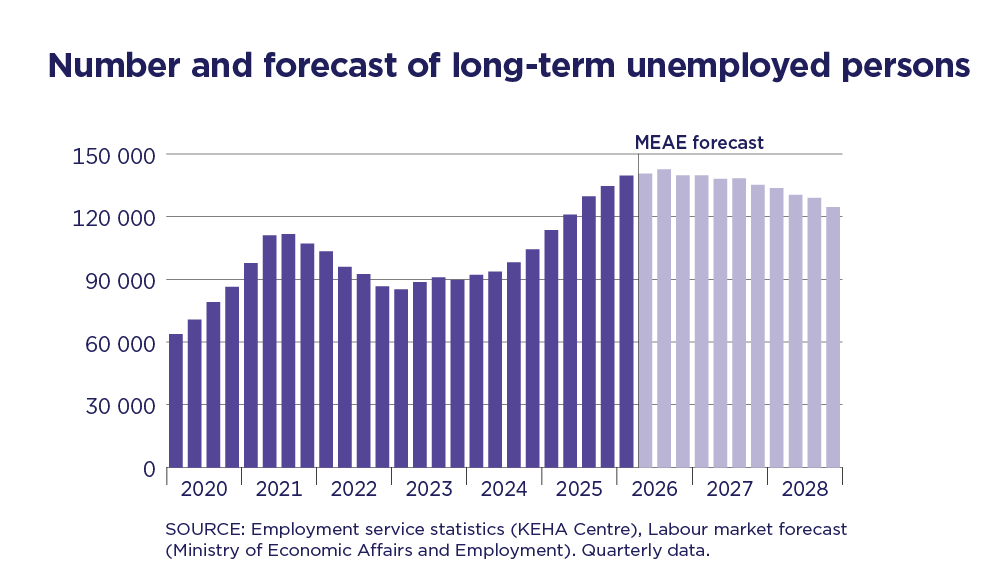
Finland’s Ministry of Economic Affairs and Employment forecasts that, compared with this year, employment growth will be more robust in 2027 and 2028. A decline in long-term unemployment is expected to begin after the summer of 2026.
The Ministry released its short-term labour market forecast on 19 May 2026. The anticipated improvement in employment and unemployment has been delayed amid a weak economic outlook. The forecast extends until the end of 2028.
Employment to grow but unemployment remains high
While an upturn in employment is already taking place, the change for the better will be slow. However, the growth in employment will become more visible in the next few years. According to the forecast, the number of employed people is expected to increase by 18,000 in 2027 and by 25,000 in 2028.
The unemployment rate is estimated to remain high in the short term. As per the forecast, it would hover around 10.2 per cent in 2026. Meanwhile, the unemployment rate is expected to fall to 9.8 per cent in 2027 and further to 9.3 per cent in 2028.
The high unemployment rate is driven by the growth of the labour force. The supply of labour has increased considerably whereas the demand for it has remained subdued. In particular, the workforce has grown because of the increased participation of older people in the labour market. On the other hand, the working-age population is not expected to grow significantly in the next few years. Immigration is estimated to fall to the 2021 level due to a decline in work-based immigration and the number of Ukrainians receiving temporary protection.
Turn for the better in long-term unemployment
The decline in long-term unemployment is expected to begin earlier and to be quicker than what was projected in the two previous labour market forecasts. According to the current forecast, the number of long-term unemployed people would rise to around 144,000 people in summer 2026, but would start to fall after that.
In terms of regions, unemployment is projected to decline the fastest in Lapland and Kainuu in contrast to Kymenlaakso and Uusimaa where the fall will be the slowest.
The number of unemployed jobseekers is expected to begin decreasing across the country in the first half of next year.
Key forecast results:
| Year | 2026* | 2027* | 2028* |
|---|---|---|---|
| Employment rate 20–64-year-olds | 76,0 % | 76,4 % | 77,0 % |
| Employment rate 15–64-year-olds | 71,4 % | 71,8 % | 72,3 % |
| Employed people 15–74-year-olds | 2 592 000 | 2 610 000 | 2 635 000 |
| Unemployment rate | 10,2 % | 9,8 % | 9,3 % |
| Labour force participation rate | 69,2 % | 69,4 % | 69,6 % |
| Unemployed jobseekers | 342 000 | 338 000 | 324 000 |
| Long-term unemployed people | 141 000 | 138 000 | 129 000 |
| Young unemployed people | 42 000 | 43 000 | 41 000 |
*forecast
What is the labour market forecast?
The Ministry of Economic Affairs and Employment produces a short-term labour market forecast twice a year. The forecast is based on a statistical time-series analysis. It makes use of Statistics Finland’s Labour Force Survey, KEHA Centre’s Employment Service Statistics, national account statistics, demographic statistics and forecast, the Finnish Immigration Service’s statistics, and the Ministry of Finance’s economic forecast.
Inquiries:
Liisa Larja, Senior Specialist, Ministry of Economic Affairs and Employment, tel. +358 295 047 036 (labour demand and employment)
Erno Mähönen, Senior Specialist, Ministry of Economic Affairs and Employment, tel. +358 295 047 083 (unemployment and labour supply)
Juho Peltonen, Senior Specialist, Ministry of Economic Affairs and Employment, tel. +358 295 047 119 (immigration)