EU Integrated Crisis Management Course – Improving Capacities in Civilian Crisis Management
The European Union Integrated Crisis Management Course (EUCIM) was implemented at FINCENT during 18 -23 September 2022. The EUICM is currently the flagship EU course that is conducted at FINCENT, and it is executed together with the European Security and Defence College and CMC Finland.
The aim of the course is to improve the understanding of crisis management in the context of the EU Integrated Approach to External Conflicts and Crises. The students are taught on topics such as the EU Global Strategy, conflict analysis and prevention, the role of gender mainstreaming and human rights law, as well as strategic decision-making among many others.
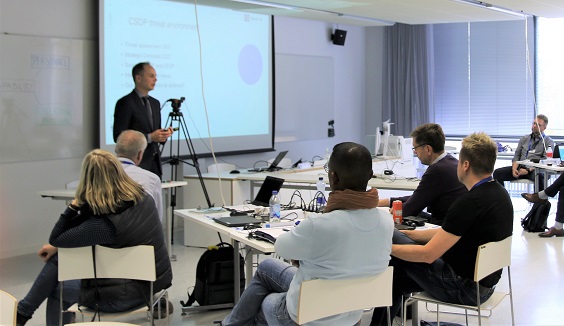
This autumn’s iteration of the EUICM saw students arrive at Santahamina from 13 different countries for a fully immersive week of study. Among these students was Mr Alain Razafindrainibe, a French gendarme with over thirty years of experience, and currently deployed on the CSDP Mission in Niamey, Niger as the Coordination and Operation Room Adviser. With a lengthy career in international relations, Mr Razafindrainibe came to the course expecting to increase his understanding of the continuity between strategy as developed in Brussels, and action during the mission. In addition, the course seemed like a perfect opportunity to develop his professional expertise and increase his network.
One of the many intended outcomes of the course was indeed a week of active networking with the students and instructors, all of whom were oriented towards and worked within the field of civilian crisis management. Throughout the course, discussion was encouraged within and outside the classroom, which resulted in an intensive course experience for participants who represented a variety of different career paths. When asked about the contents of the course, Mr Razafindrainibe also highlighted:
- I particularly enjoyed the syndicate work sessions, which allowed us to compare our different points of view on the same topic.
Small group work such as syndicate work undoubtedly contributes towards a more comprehensive understanding of the topics at hand, as it encourages students to engage more freely with their peers and enables lively exchanges. Additionally, Mr Razafindrainibe thought the course was high-level and stimulating:
- The combination of lectures and table top exercises made the course very interesting, and it was also very enriching to interact with participants with so many different backgrounds.
The course aims to help students get a thematically comprehensive understanding of the EU’s Crisis Management Operations and their facilitation. After the EUICM, students should come out better prepared for future challenges in their fields, and with the help of our expert instructors we hope they leave with a wealth of knowledge.
Mr Razafindrainibe was surprised to learn about how Common Security and Defence Policy (CSDP) missions are financed and how the roles of internatinal organizations (IOs) and non-governmental organizations (NGOs) manifest themselves in crisis management. While perhaps unexpected, this information is sure to be helpful as Mr Razafindrainibe aims to connect his work in the field with the standards and goals imposed by Brussels. In fact, he was able to demonstrate this connection as he presented his tasks at EUCAP SAHEL NIGER to course participants and instructors. The presentation linked the EU Integrated Approach to External Conflicts and Crises with civilian crisis management in the field, giving the audience a great perspective into how to utilise the skills learnt on the course in their work in the future.
Thanks go to all participants, instructors and facilitators! The next EUICM will be held in 2023 (Q3).