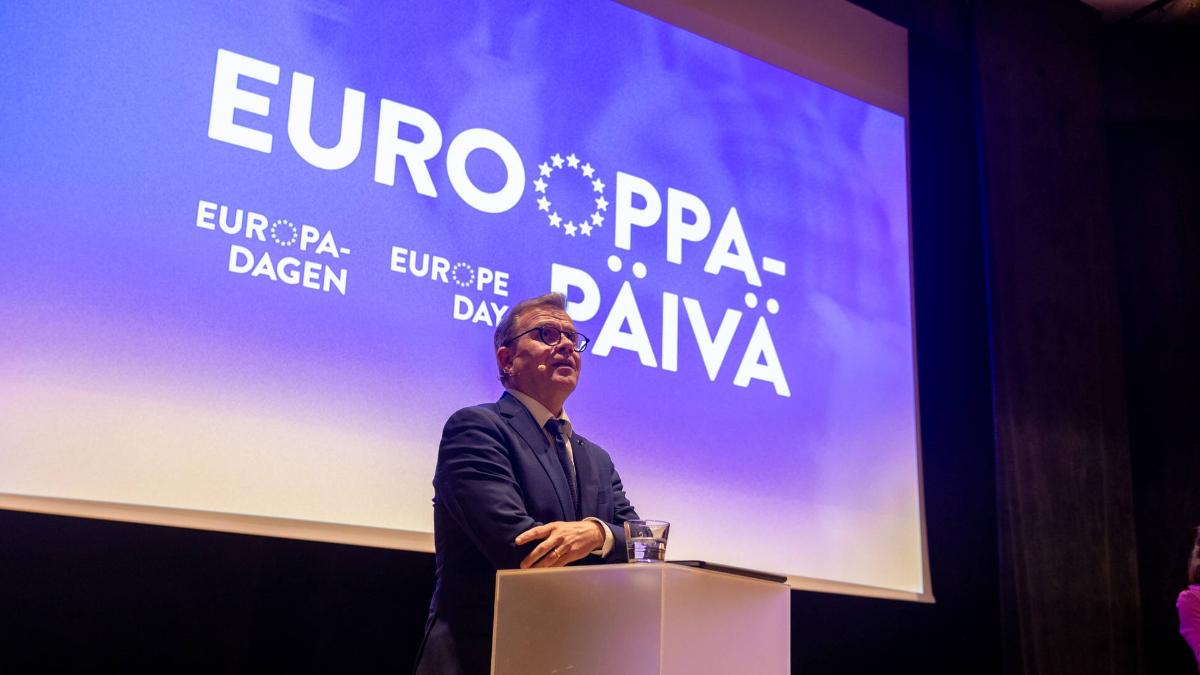
Prime Minister Petteri Orpo’s EU policy speech on Friday 8 May 2026
(Check against delivery)
Dear friends, dear students,
Happy Europe Day Eve!
When was the last time you stopped to think about Europe? I’m not talking about news or politics, I mean the European cause. Is it worth defending?
That’s something I’ve been thinking about for my entire political career. One of the first things I did in politics was to campaign for Finland’s EU membership in the early 1990s. But I’ve never thought about it as much as I do now.
Europe is not a given.
It is normal to think that the world will keep going in the same direction. We are used to thinking that the world around us works according to certain rules. That democracy moves forward and that cooperation overcomes confrontation.
We have to admit that the world around us has changed. Not everyone is willing to defend the international rules-based world order. But it would be an exaggeration to say it has collapsed. It has not, but we need to work harder now to keep it intact than we have for a long time.
Russia is waging a war of aggression in Ukraine and is trying to reshape the entire European security order to suit its interests. The United States’ role in European security is diminishing. China is strengthening its position on its own terms. Instability is deepening in the Middle East. Europe cannot build its security on the old assumptions.
This is the world in which we must act.
That is why we have to ask ourselves: what is Europe’s place in this world? What role should we take on, and what kind of world do we want to see?
The answer goes back to why Europe exists in the first place. The European Union is more than just an economic area or a regulatory environment. It is more than just an institution. It is a community of values – and increasingly also a geopolitical community.
There may be cracks in the rules-based order, but it is still the best possible system for a country like Finland. It is in our interest to defend it.
But just as importantly: we can’t be naive.
We have to be honest. Those with military power and technologies are the ones who control the world. And that is exactly why Europe needs to develop those capabilities.
Europe needs to see the world as it is. Not as it was after the Cold War. And not as we'd like it to be.
Dear friends,
All of this leads us to an inevitable conclusion: Europe needs to be stronger. Not because the use of force is an end in itself. But because without power, our values have no weight. We cannot defend Europe with values alone, without the concrete ability to fight for them.
We need a stronger economy. Stronger security. Stronger defence. A stronger role in external relations. We also need to be stronger internally, in our decision-making and structures.
There are 500 million of us. We are one of the largest economies in the world. We have expertise, stability and trust. All too often we forget this, and we don’t always act on these strengths.
We need to boost our competitiveness. Economic strength is the foundation for everything we do. Without it, we cannot build security or defence.
We need to build genuine security for Europe through the defence industry and sovereign capabilities.
We need to regain our position as tech leaders and build sovereignty in that area as well. Investments in artificial intelligence, space and other new technologies, such as chips and quantum, are essential.
We must be able to make decisions. A situation where one country can take the rest of Europe hostage and block decision-making is not sustainable. That is why we need the courage to increase qualified majority voting.
We should also be prepared to proceed with integration at different speeds. It is in Finland’s interest to be involved in those areas where the EU is moving forward, be it defence, capital markets or critical raw materials.
Dear friends,
It’s easy to say that the EU is ineffective. But the truth is a lot more complex. When it comes to combating climate change, protecting the environment and promoting sustainable energy, the EU is a global leader. Thanks to the EU emissions trading system, electricity production in Finland is now 95 per cent clean.
And there are a lot of other good examples of the EU working well, such as the Erasmus exchange programme, roaming and universal charging ports. A lot of the time, European integration is motivated by practical needs rather than lofty visions.
At this very moment, we are removing barriers from the EU single market and building a capital markets union so that European businesses can develop and grow here in Europe. We are also significantly increasing our investments and deepening cooperation in defence. These are very important themes for Finland.
At the same time, Finland has been proactive. Last year in Helsinki, we launched the Eastern Flank cooperation format for defence and security along the EU’s eastern border. This autumn, I will be hosting the European Arctic Summit, where discussions will focus on the significance of Arctic security policy for the European Union. EU’s Arctic border starts from Finland’s eastern border.
Dear friends,
Strength and realism do not mean giving up on our values. In fact, it’s quite the opposite.. Right now, European values are even more important than before.
Democracy is not a matter of course or a default setting. It is a choice we make every day. And if we do not make this choice, we will move in the opposite direction. We saw this in Hungary. But we also saw what happened when people used their voices. Democracy corrects itself when given a chance.
The rule of law is neither a technical detail nor a negotiating tool. It is the difference between power and arbitrary rule. It is the foundation on which everything else is built – including the economy. Europe must not lose sight of this. Even when it's hard.
Finland was involved in creating the rule of law mechanism that led to the freezing of Hungary’s EU funds. We must continue to strengthen this mechanism. We cannot allow our common funds to be used in a way that weakens the foundations of democracy in any EU Member State.
This is the direction Europe should take: realism without cynicism and values without naivety. These are not contradictions in terms.
Dear friends,
For a long time, Finns mainly viewed the European Union as an economic community. According to a recent study by Sitra, this view has changed. Finns increasingly see the EU as a geopolitical actor whose task is to safeguard stability and security. According to the Sitra study, people support even ambitious decisions if they feel they will improve the ability of Europe and Finland to function. People still expect a lot of Europe. And there is more demand for Europe today than there has been for a long time.
Around the world, countries are looking for a partner that offers stability, predictability and reliability. This is reflected in how the world sees Europe. We are concluding or have concluded new trade agreements with Latin American countries and India, for example. Canada is looking to deepen cooperation with Europe, and after a little self-reflection, the UK has decided to do the same. This is a huge opportunity.
To take advantage of this opportunity, Europe needs self-confidence. We need to believe that we have a lot to offer. And we know we do, because of many countries’ strong will to join the EU.
The debate on EU enlargement is overly dominated by sector-specific concerns and technical challenges. We need to focus on what’s important. The core purpose of the EU is to create peace and prosperity for Europeans. We should welcome all countries that share our core values and goals. This message should be strong and clear.
Dear students,
Your generation will determine what kind of player Europe will be. Will it be cautious and reactive, or will it have its own vision and the ability to implement it? I think it will be the latter. But it won’t happen without conscious decisions and the courage to act.
At the start of my speech, I asked whether Europe and the European cause were worth defending. The answer is still yes, just as it was in the 1994 referendum. Because right now, at this point in time, Europe is the only structure that can protect what we believe in. Europe is not a project of the past. It is a project for the future.
Thank you.