
Government Palace
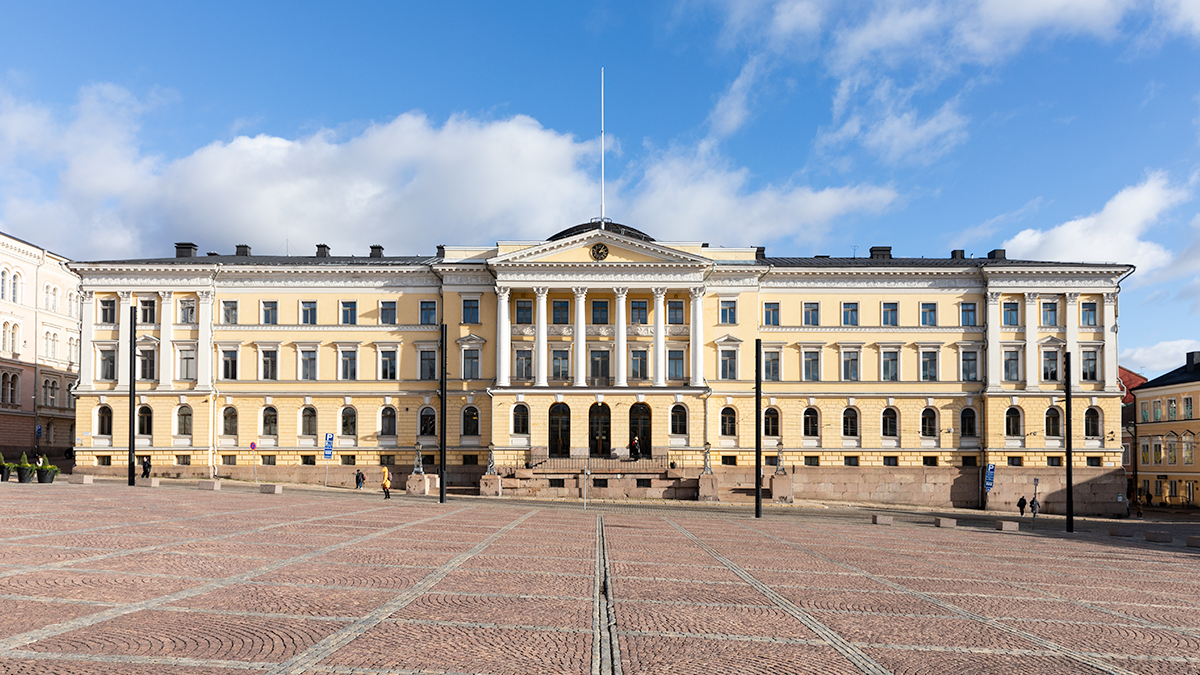
The Government Palace overlooking Senate Square is a national memorial and key monument of Finnish architecture and cultural and political history.
The building’s name at different times:
- 1822–1918 House of the Senate
- 1918– Government Palace
The building has served as a government palace and workplace for government officials since 1822. It has been built, repaired, modified and protected in accordance with the cultural and historical values, economic and technological opportunities and usage requirements typical of each era.
The Government Palace was originally designed to be used by the entire Finnish central government. For a long time, citizens could freely access the Palace to handle their official matters. It was not until the 1990s that restrictions on citizens’ access to the Palace were introduced. Today, the Palace is only open to government employees. As public administration expanded, government agencies began moving out of the Palace, they were followed in the 1960s by various ministries.
The Government Palace currently houses the Prime Minister’s Office, the Ministry of Finance and the Office of the Chancellor of Justice. Hundreds of people work at the Government Palace every day. The building will undergo an extensive renovation between 2026 and 2030. The Government Palace was last renovated in stages between 1974 and 1996.
History - From House of the Senate to Government Palace
The Government Palace was built as a symbol of the newly established Grand Duchy of Finland. Following the Finnish War, the Kingdom of Sweden ceded Finland to the Russian Empire in the Treaty of Hamina in 1809. The area of Finland became an autonomous grand duchy, in which the Swedish laws and social order remained in force.
Helsinki, home to approximately 4,000 inhabitants, had suffered a severe fire in 1808, and plans for the town's reconstruction had already been made. In 1811, Johan Albrecht Ehrenström drew up an ambitious plan, the goal of which was to create a monumental city centre for the capital of the Grand Duchy of Finland, with buildings for both civilian and military administration. The buildings were to symbolise the Emperor’s power and the power of officials enforcing his wishes.
Helsinki was declared the capital of the Grand Duchy by imperial rescript in April (March in the Julian calendar) 1812. This decision also stipulated that the new capital was to be constructed according to Ehrenström’s plan and that the Governor-General and Senate were to remain in Turku until the public buildings for them had been built. In practice, transforming Helsinki into a capital city thus required the construction of administrative buildings for the central government of the new political entity, the Grand Duchy.
The realisation of Ehrenström’s vision was assigned to Carl Ludvig Engel, a German architect. His first task was to design a building for the Senate and central agencies. In Ehrenström's grid plan, a space was reserved for the building on the eastern flank of Senate Square.
The construction of the Government Palace, covering an entire block, began in 1818, and the wing on the Senate Square side was first used in 1822. The wing on the Aleksanterinkatu side was completed in 1824, the wing on the Ritarikatu side in 1828, and the wing on the Hallituskatu side in 1853, enclosing the block.
Over the years, the Palace has housed various operations, including a public library and reading room, the university library, Senate archives, statistics office, ministries and government agencies. The University of Helsinki also began operating in the building before its own main building was completed in 1832. The building designed by Ricardo Björnberg as the Senate printing press was completed in the courtyard in 1900. It was connected to the wing on the Aleksanterinkatu side with a two-storey passageway (“Bridge of Sighs") built in the 1950s.
The central government of the newly independent Finland was formed in 1917–1919 and based on the system in place during the Grand Duchy. The Emperor was replaced by the President, the Senate’s Economic Division became the Government and the Judicial Division the Supreme Court, while the names of administrative departments were changed to ministries. Senators became ministers, the Vice-Chairman of the Senate’s Economic Division became the Prime Minister, and the Procurator became the Chancellor of Justice. The name of the building was changed from the House of the Senate to the Government Palace.
Architecture
The Government Palace was the first building constructed on the new Senate Square, and it defined the style of the entire monumental centre of the new capital. In style, the Palace represents the Empire style that Engel adopted in St Petersburg. It is a form of Neoclassicism that draws its inspiration and ideals from antiquity.
Overall, the Senate Square designed by Engel consistently follows the ideals of classical architecture. It is a very European square with an architectural heritage dating back to ancient Greece and Rome, passing through Stockholm to Italian Renaissance and the Empire style of St Petersburg.
It was important for Engel that the facades should reflect the purpose of the buildings. The facade of the Government Palace displays intentional references to antiquity and Rome. The Corinthian columns symbolise the building’s status as an office of power and administration. For the University’s main building on the other side of Senate Square, Engel drew Ionic columns symbolising education and learning. The Pantheon-type dome of the Palace can be considered as a reference to ancient Rome and its Senate.
Clocks of the Government Palace
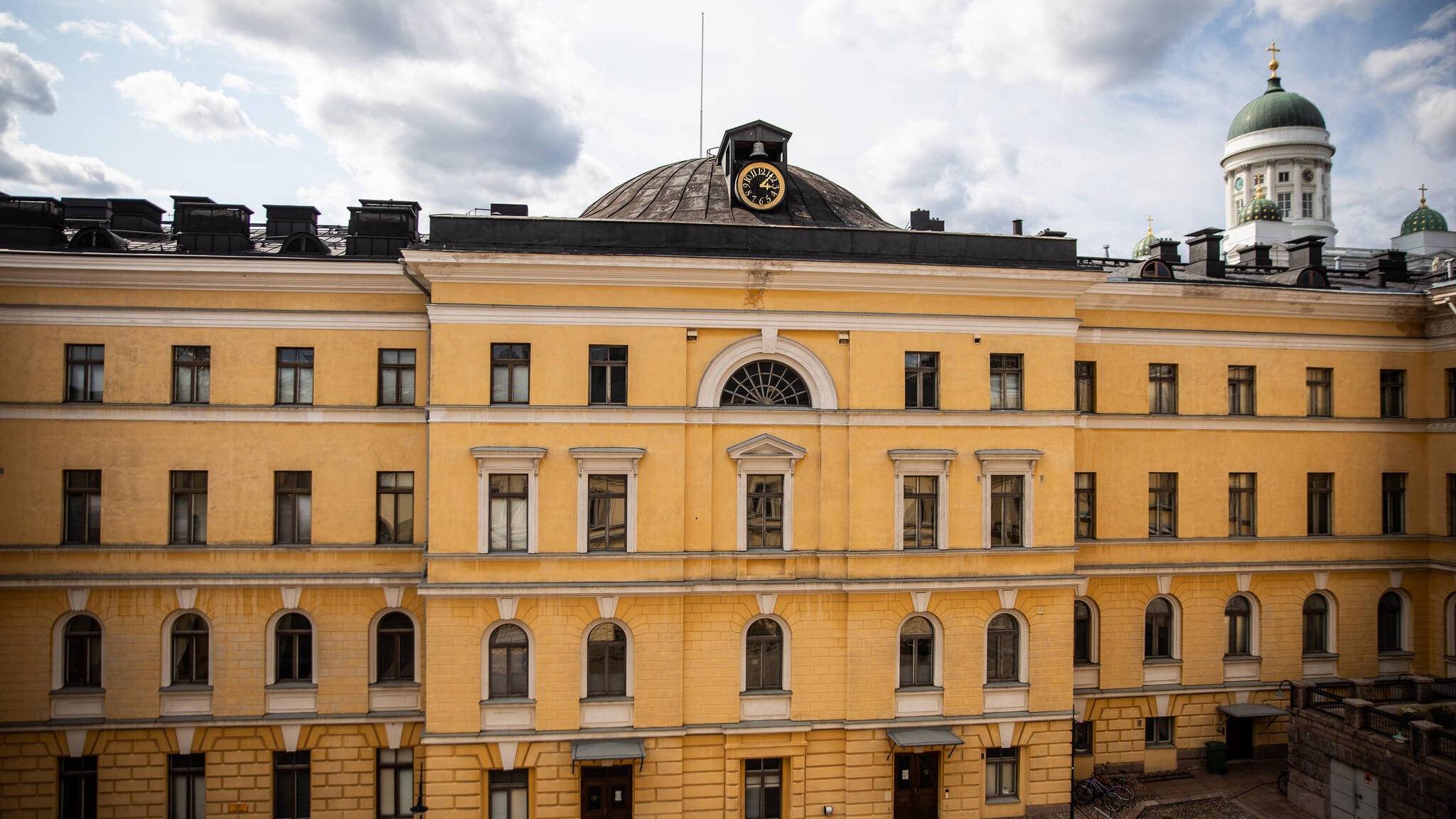
The clock on the tympanum, made by Jaakko Ala-Könni, has displayed the time since 1822. The same machinery is used by the tower clock in the courtyard, which chimes on the hour and half hour for the officials in the building. The clockwork crank rotation was electrified in the 1980s, but otherwise, the exceptionally well-preserved clockwork still runs mainly with the original solutions and parts.
Mechanical clocks are still in use in the Government Palace. They are wound manually during a maintenance round every Wednesday. During the round, the clockmaker also checks the time of the tympanum clock and schedules the raising of the weights performed by an electric motor.
Interiors
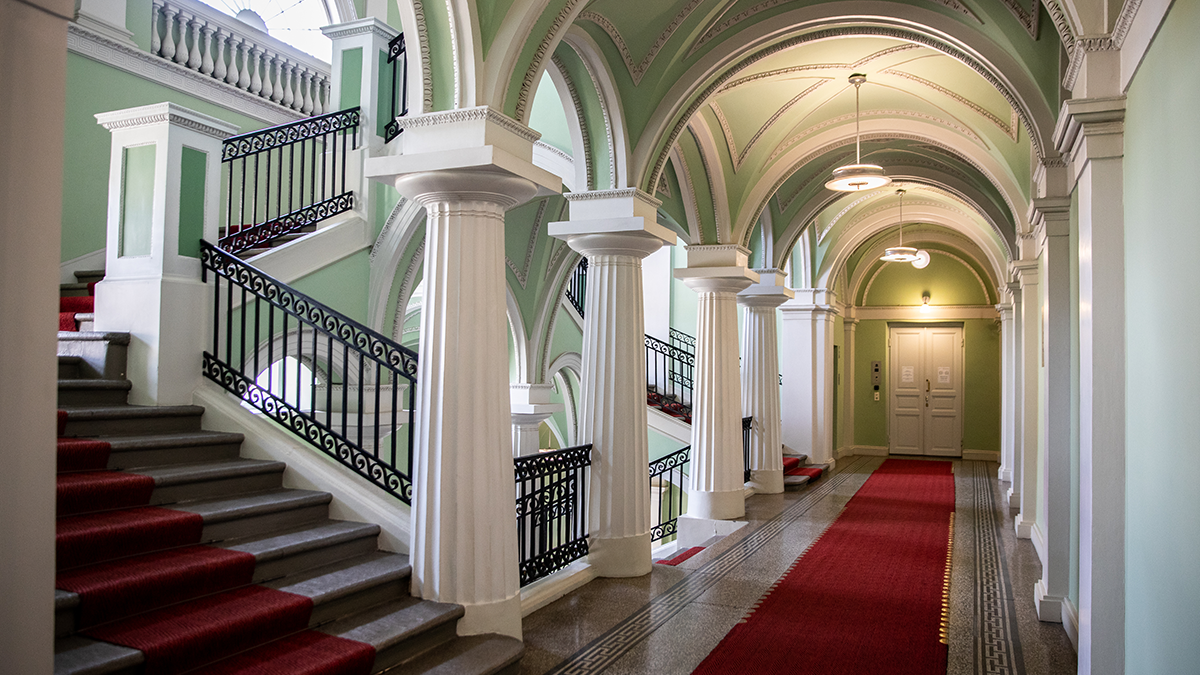
Opening from the entrance to Senate Square, the main Palace staircase is unparalleled in Finland, and architect Engel was particularly proud of it. Engel modelled the ceiling dome on the Pantheon in Rome. The ceiling and walls feature symbols referring to antiquity that were recognisable to the educated class of the time. In terms of space, the staircase largely retains its original form, but the colours and lighting have seen some changes due to contemporary ideals. The staircase was a public space open to citizens until the 1990s. In 1997, access control, facilities for the attendant and an X-ray device were set up in the lobby.
The second-floor staircase landing features a plaque reflecting the political atmosphere of 1933, the year it was placed there in commemoration of the political murder of 16 June 1904, when Eugen Schauman, a civil servant, shot Governor-General Nikolai Bobrikov and himself.
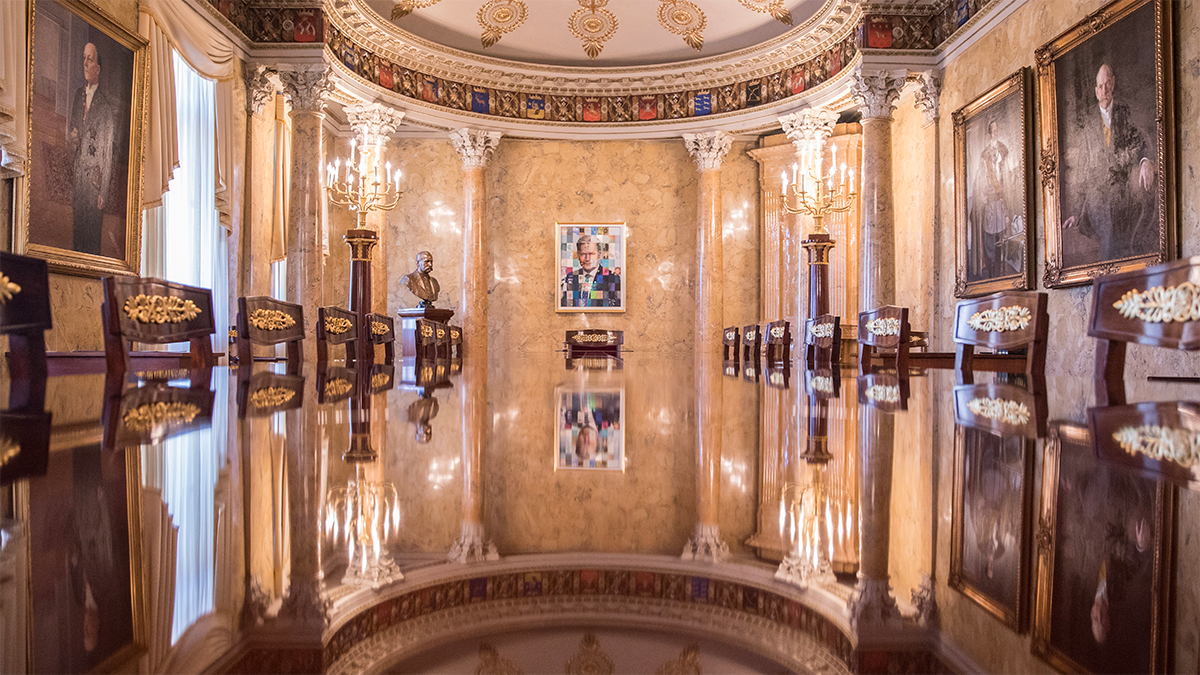
The Presidential Room, the most distinguished room in the Government Palace, largely retains its original look. The room has been slightly renovated, and the table was replaced with a newer one during the renovation in the 1990s because the old table was too low for people today. The chairs and the standing candelabra were designed by Engel. The ceiling is decorated by the coat of arms of the historic provinces of Finland. The furniture and clock were made in St Petersburg. There is a Bible on the table, on which ministers may place a hand if they wish when taking their oath of office. The Bible dates back to the 1600s and is one of the first Bibles entirely in Finnish.
On the walls are portraits of the presidents of Finland. During the period of autonomy, the Presidential Room was the Senate Assembly Hall, or the imperial throne hall. The imperial throne stood behind the chairperson's seat, and the hall was decorated with portraits of Russian emperors, the grand dukes of Finland. Finland’s declaration of independence was issued in the hall on 4 December 1917. It was approved by Parliament two days later.

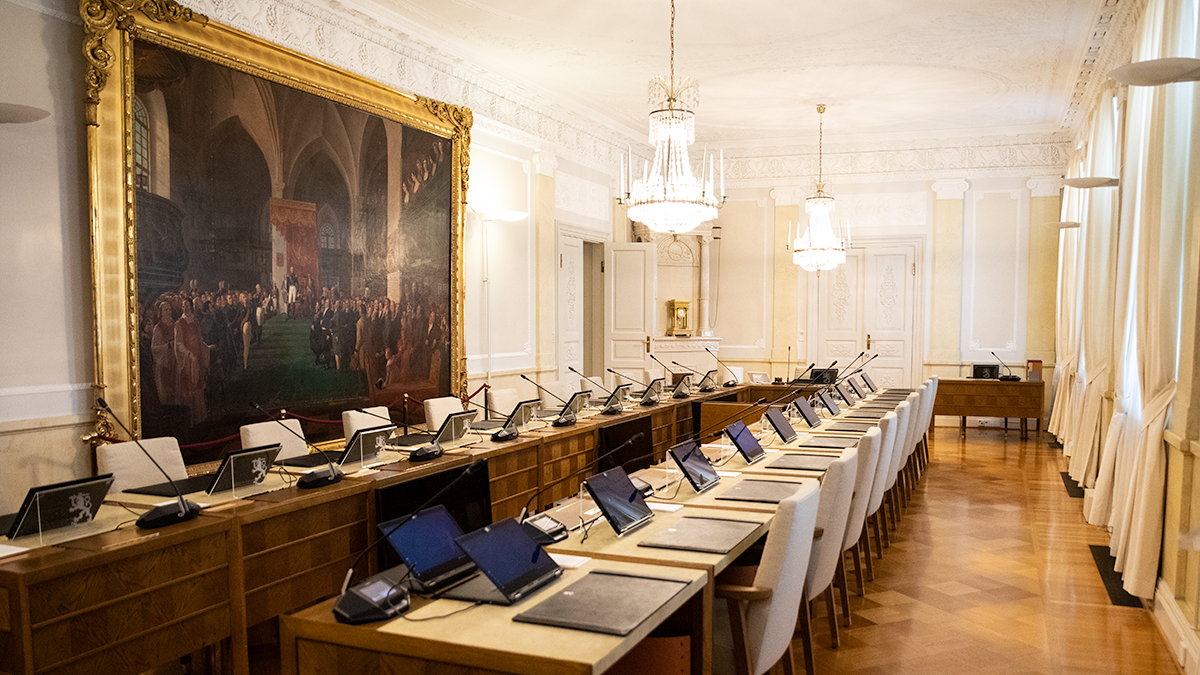
The furnishings of the Prime Minister’s office have remained largely the same for 200 years. This room was restored in the 1990s. The painting on the wall can be changed according to the current Prime Minister’s preferences. The doors of the office open to the Government Session Hall. The Session Hall is dominated by Robert Wilhelm Ekman's nearly floor-to-ceiling painting (1858) depicting the opening ceremonies of the parliamentary session in Porvoo. The Session Hall was expanded before the Senate's centenary celebrations in 1916 making it an impressive and valuable space.
The current interior design of the Government Session Hall is from the 1990s. In spring 2020, during the coronavirus pandemic, large screens were added to the Session Hall to enable ministers to participate in sessions from different rooms or remotely.