
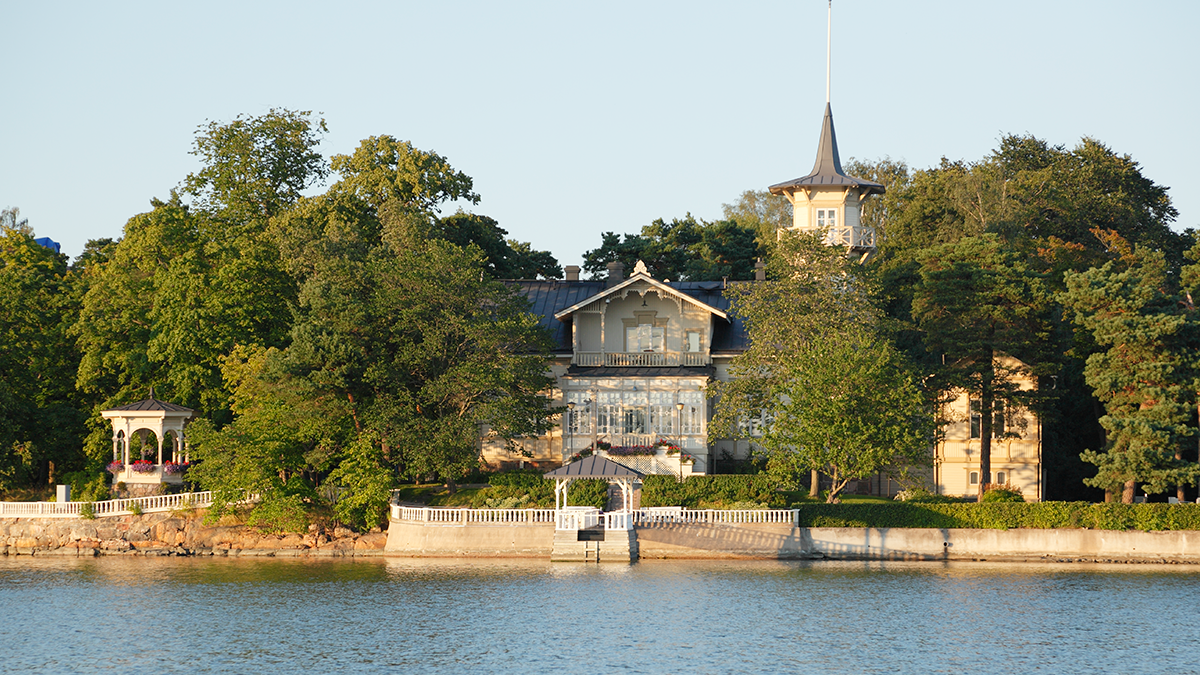
Prime Minister's Official Residence
Kesäranta, the Prime Minister’s official residence, is located in the Meilahti district in the western part of Helsinki.
The building’s use at different times:
- 1873–1904 Private summer home
- 1904–1917 Governor-General’s summer residence
- 1922–1952 Prime Minister’s summer residence
- 1952– Prime Minister’s official residence
Villa for Governor Generals
The architect Frans Ludwig Calonius designed and built the villa in 1873 on a plot of land he had leased from the City of Helsinki. At that time, the plot on the southernmost peninsula in Meilahti was located outside the city limits. The building was given the name Villa Bjälbo.
The next owner of the villa, Carl Robert Ignatius, the cashier of the Bank of Finland, made significant modifications to the building, adding a tower and a veranda overlooking Seurasaari Island and the evening sun.
In April 1904, the Senate Economic Division purchased the villa for use as the Governor-General’s summer residence, a decision made in secrecy. The decision was kept secret because the oppressive Russification policy of the time had made Governor-General Bobrikov and the Senate very unpopular among citizens.

Although the aide-de-camp of Governor-General Prince John Obolensky described Kesäranta as a ‘spice box’ unfit for the likes of a Russian prince, the governors-general who succeeded Bobrikov led vibrant social lives in the villa during the summer.
During the civil war, the villa first served as the headquarters of the Red Guard and later as a residence for German Baltic Sea Division Commander Rüdiger von der Goltz, followed by Regent Carl Gustaf Emil Mannerheim.
In the early 1920s, when the Kultaranta villa in Naantali was acquired for use as the summer residence of the President of the Republic, the title of Villa Bjälbo was transferred to the Prime Minister’s Office. The first prime minister to live at Kesäranta was A. K. Cajander in 1922.
Prime Minister's Official Residence
It is thought that the name Kesäranta was first used for the villa when the State purchased the plot from the City of Helsinki in 1927. In 1952, during Urho Kekkonen’s term as Prime Minister, the official residence proper at Vuorikatu 1 in the centre of Helsinki was vacated and Kesäranta was renovated for year-round use. This period also saw the construction of a waterfront sauna.
Governments in the post-war period were so short-lived that the prime ministers often felt that moving to Kesäranta was not worth the effort. However, a large number of receptions and events were organised there at the time. The monthly interview with the Prime Minister was broadcast from Kesäranta for the first time in April 1969.

When the Kesäranta villa fell into disrepair and its condition deteriorated in the early 1970s, the state considered selling the property. However, as the historical value of the villa increased, and as the Prime Minister’s meetings and events with international contacts grew more frequent, the decision was made to refurbish the building thoroughly in the early 1980s. Kesäranta also underwent extensive renovations in the early 2000s and again in the early 2020s. Prime Minister Esko Aho lived at Kesäranta throughout his term of office. Paavo Lipponen, Matti Vanhanen, Mari Kiviniemi, Jyrki Katainen, Sanna Marin and Petteri Orpo have also lived there.
In addition to being the Prime Minister’s official residence, Kesäranta serves as a venue for meetings, events and press conferences.