The exercise proved it: Together we are stronger

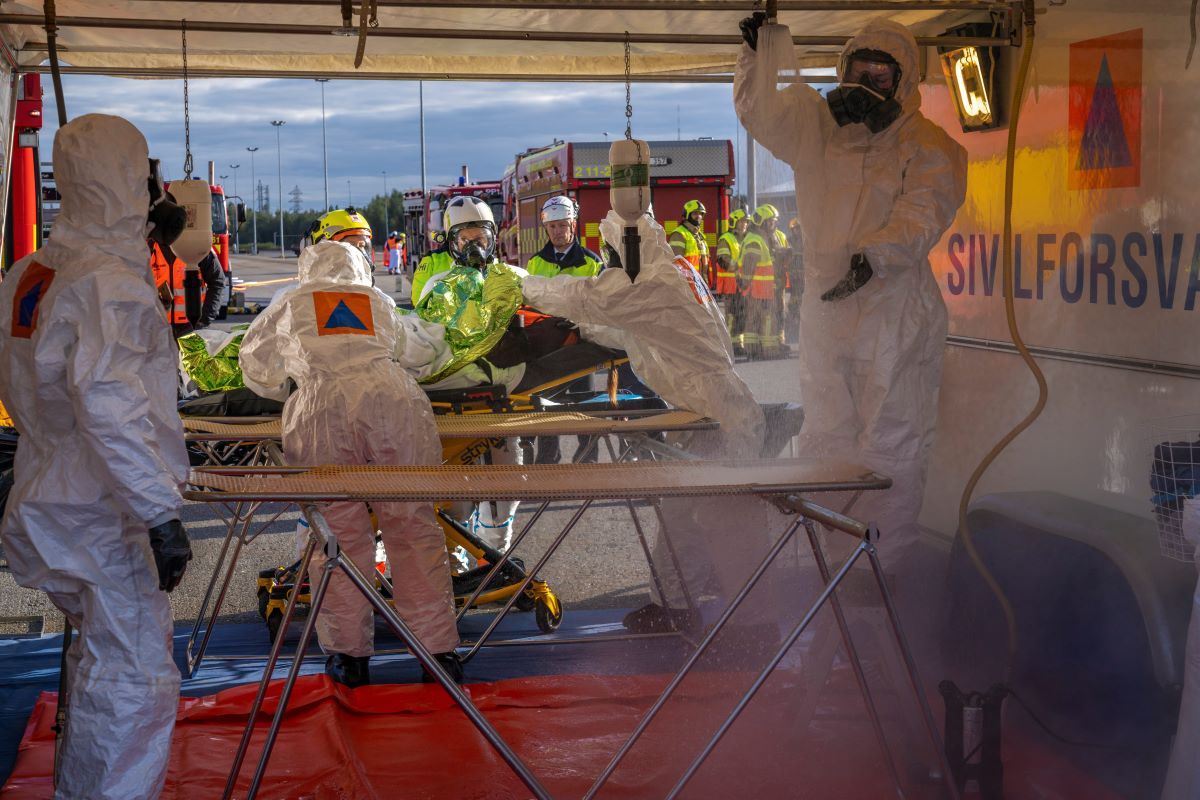
The Rescue Borealis exercise, conducted in Finland between August and October 2025, brought together around 700 professionals from healthcare, rescue services and other security authorities from Finland, Sweden, Norway and Germany. This multi-agency exercise, which was mainly funded by the European Commission and focused on chemical, biological, radiological and nuclear threats (CBRN), was reportedly the largest of its kind in Europe in recent years. It gave a significant boost to preparedness and readiness in the Nordic region.
When you can’t cope on your own
The exercise consisted of four progressive phases and numerous sub-exercises, which involved training, practising and testing individual skills, unit leadership and command centre operations. Particular attention was paid to national and international cooperation between authorities, and to the provision and reception of international assistance. One of the main objectives of the exercise was to test and further develop the interoperability of the authorities and their ability to work together in scenarios involving foreign assistance.
In the exercise scenario, a CBRN emergency escalated rapidly in North Ostrobothnia, exceeding both regional and national resources. At Finland's request, two assistance mechanisms were activated simultaneously. One was based on the intergovernmental Agreement on Cooperation within the Field of Emergency Prevention, Preparedness and Response, also known as the Barents Agreement, which enables cross-border assistance between the northern regions of Finland, Sweden and Norway. The other drew on the extensive resources of the EU Civil Protection Mechanism, including materials from the strategic rescEU CBRN and rescEU Medical Stockpiles hosted in Finland, and was supported by a team of experts as well as a medical evacuation aircraft operated by Norway.
An exercise of unprecedented scale
The exercise culminated in a five-day field training exercise phase in Oulu in late September and early October. The multinational training audience was supported by authorities, institutions and the City of Oulu, along with companies and organisations such as the Finnish Red Cross, and individual professionals from Poland, Hungary, Estonia, France and Denmark. A local voluntary fire brigade covered a substantial share of the logistical support and coordinated the role-players for casualty simulation, playing a key role in enhancing the realism of the exercise.
The visitor and media day in Oulu attracted 140 participants, including Finland’s Minister of the Interior, the EU Commissioner responsible for preparedness and Sweden’s Minister for Civil Defence. The exercise demonstrated to the international community how the Finnish concept for comprehensive security works in practice. It also embodied the principle of the EU’s Preparedness Union Strategy: broad-based preparedness cooperation that transcends administrative and national borders is essential.
Aiming for continuous improvement
Daily hotwash-up discussions provided constructive insights into successes, failures and, more importantly, conclusions for improving expertise, equipment, procedures, interoperability and guidelines. The field training exercise provided an excellent platform for sharing and learning from good practices.
One of the lessons learned from the exercise was that receiving and effectively using foreign assistance in an incident that has a broad impact on society require mutual understanding between those providing and receiving assistance. It is enough for the message to be understood – even using hand gestures. However, based on experience, it is advisable to systematically improve communication skills face-to-face, on the radio and by telephone in English. Systematic assessment of the observations made during the exercise is still ongoing.
The journey continues
The work is set to continue. The training container capability, developed under the rescEU CBRN Stockpile Project and comprising trainers, materials and a specially designed container, was used for the first time in Oulu. Next, it will embark on a national training tour, after which it will support partner countries’ rescue services and other authorities in preparing for CBRN emergencies. The training will be delivered by the splendid members of our pool of rescEU CBRN experts, who demonstrated outstanding skills during the exercise in advising on the safe and effective use of materials from our stockpiles.
Pertti Kelloniemi
Rescue Borealis 2025 Exercise Coordinator
Ministry of the Interior, Department for Rescue Services

Photo: Finnish Defence Forces, Combat Camera